

SEO FAQ
SEO Copywriting for
Home & Lifestyle Brands
Straight-talking, no-jargon answers to get your site ranking for interiors and lifestyle businesses.
Don't be put off by the terminology. Whilst some agencies might try to blind you with technical jargon, the principles of SEO are really quite straightforward. It's search engines' way of helping users, by matching them with the best answer to queries from the most trusted sources. When you optimise your site, you're making it easier for search engines to understand what you offer and connect you with people actively looking for your products or services. But it helps to know how optimising for AI search, Google, and snippets varies—though all are based on the same core SEO principles.
Is SEO Too Technical For Me?
(Search Engine Optimisation)
SEO is the process of optimising your website to improve its chances of getting seen by people searching on Google and other search engines.
Organic listings rank your site by matching your content to specific search terms, selecting the best ‘fit’ based on relevance, website authority, and ease of use. Your ranking position is influenced by a combination of technical and non-technical factors.
More on that below.
What is SEO?
Online searches are by far the most popular way to discover local businesses. When people search for a product or service 'near me' or in a specific location, Local SEO helps place your business in Google's map results (known as the ‘map pack’).
Ranking is determined by organic factors such as relevance and website authority, alongside your business location, which is set through your Google Business profile.
What is Local SEO?
(Answer Engine Optimisation)
AEO refers to optimising content for Google’s Featured Snippets or People Also Ask which appear above organic rankings in traditional search engines. Featured Snippets directly extract content from high-ranking web pages selecting content that best answer user’s queries based on Google’s own algorithm. Snippets suit question-based searches eg ‘best green paint for small bathrooms’. They signal trust to potential clients that can influence future decisions when ready to take action.
What is AEO?
(AI Optimisation)
AI-powered search tools such as Perplexity and ChatGPT answer queries by pulling from trusted online sources. AIO is the process of improving your website content for inclusion and reference. Getting cited is influenced by factors such as clear content structure and machine-readable labels (schema markup) as well as many of the principles that apply to traditional SEO, including authority, trust and expertise.
What is AIO?
(Generative Engine Optimisation)
GEO and AEO are closely related and often used interchangeably. The subtle difference: AEO optimises content for both ChatGPT and similar AI searches whilst GEO focuses specifically on AI Searches only such as ChatGPT and Perplexity. AI tools favour conversational searches, e.g. ‘‘What’s better for rentals: laminate or vinyl flooring?’’ rather than traditional queries such as ‘‘laminate flooring’’ or ‘‘Ikea, London store.’’
What is GEO?
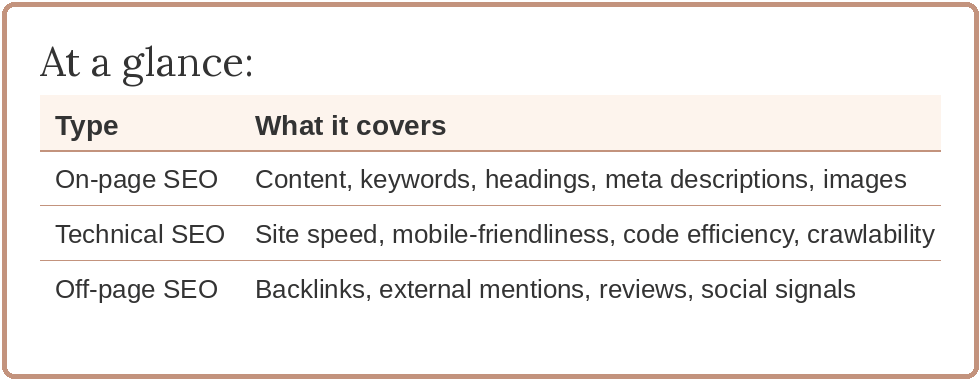
On-page SEO is the process of optimising your website pages for search engine discovery. It covers elements like content, headings, keywords, page titles, search result descriptions (meta descriptions), images, and structure. These help search engines understand and rank your pages for relevant searches.
What is On-Page
SEO?
Off-page SEO focuses on factors outside your website that influence your search rankings. It includes backlinks (from other websites to yours), online reviews, social media mentions, and brand citations. These signal to search engines that your site is trusted and authoritative.
What is Off-Page SEO?
Technical SEO focuses on your website's backend performance — fast loading, mobile-friendly display, and efficient code that keeps your site running smoothly, so search engines can easily access and index your pages.
What is Technical SEO?EO?
Understanding Modern SEO
Optimising for current search is a multi-faceted approach that goes far beyond basic implementation. When your web designer says they've "included SEO," they may have only scratched the surface—which could explain why you're not seeing noticeable results.
Effective SEO requires a deep understanding of:
*How your business operates
*Who your clients are and what they need
*Your unique selling proposition (USP)
*Your content pillars and messaging
*Your competitive landscape
*Your geographic location and local market
SEO success comes from a comprehensive strategy that addresses technical foundations, content quality, user experience, and optimisation across all these areas.
FAQ’s
Does SEO drive more traffic than social media?
Yes, significantly more. SEO delivers long-lasting results and you own your content outright, giving you full control. Social media requires constant posting and is subject to algorithm changes beyond your control. Social mentions can boost your SEO authority (so it helps to have a presence), but for sheer volume of traffic, SEO wins.
Is it too late to start SEO?
It's never too late. You can improve your SEO at any point—the rules are the same for everyone. Established brands may benefit from high domain authority and backlinks, but they all started on an even playing field. When you're just starting out, it's easier to rank for niche topics, local searches, or untapped keywords. The sooner you begin, the sooner you'll see results.
How long until SEO shows results?
You'll typically see the full impact within 8–12 weeks, though you may notice changes sooner. Timing depends on your site's size and how quickly Google indexes your pages. The results can be long-lasting.
Why do SEO rankings fluctuate?
Think of it as a global race with new competitors constantly joining. Some improve their tactics with fresh content and quality links, moving forward; others fall back with broken links or harmful backlinks. Positions shift regularly—including yours.
Can you guarantee first page rankings?
No one can guarantee rankings. What I can do, is uncover the best opportunities to rank higher—and sometimes even #1—against your key competitors. Rankings are fluid and subject to change.
Why invest in SEO?
SEO remains the number one driver of organic traffic—far exceeding social media. It delivers passive traffic while you sleep and keeps working long after publication.
What about "zero-click" searches in AI optimisation?
Don't be concerned if you've heard that new AI optimisation results in zero-click websites. AEO (Answer Engine Optimisation) provides users with answers directly in Google search results without needing to click onto your website. If they're interested in your products and services, and they’ve seen your name cited, you will be top of mind, whey they’re ready to purchase. Measure success by revenue, not just traffic.
How do I maintain SEO rankings?
Maintaining rankings requires periodic check-ins to assess your position against competitors, address issues that may harm your site, and refresh content for optimal performance. While the heavy lifting happens upfront, it's important to address anything working against you—like broken links or toxic backlinks.
What SEO services do you include?
I focus on on-page SEO: optimising your copy structure and content, fixing broken links, and correcting missing or poorly optimised title tags and descriptions. I map keywords to pages for maximum impact, ensuring each page has a clear purpose so no two pages compete against each other. I’ll audit your site to flag technical issues and harmful backlinks—providing clear guidance for you or your web developer to address to keep your SEO ship shape. All these services come free with website packages of 4 pages or more.